
The Core Model Behind THE VIABILITY CODE
The Schließmann strategy cube
Three Dimensions of Strategic Reality
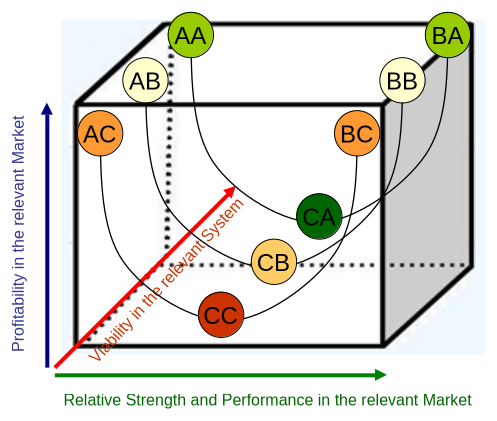
The Schließmann Strategy Cube is a model of strategic corporate management developed by Prof. Dr. Christoph Ph. Schließmann and first published in 2012.
He describes a company's strategic position in terms of three distinct dimensions:
- Relative Strength in the Strategically Relevant Market,
- Performance in this market and
- Viability within the relevant system.
These three dimensions link the company's current market position and economic performance to the question of whether its strategic configuration will remain viable even under changing conditions.
Why three dimensions?
Market position and economic performance are key indicators of strategic corporate management. Their significance relates to the company's current position and business model.
A company's viability also depends on how it is embedded in its relevant system: what capabilities it possesses, what technologies, resources, partners, or key individuals it depends on, what interdependencies exist, and how these relationships evolve in the face of change.
The Schließmann Strategy Cube transforms this systemic dimension into an independent strategic factor.
Thus, companies with similar market positions and comparable performance can be evaluated very differently from a strategic perspective if their viability differs.
The Schließmann Strategy Cube expands two-dimensional positional analysis into a three-dimensional strategic system analysis.
The Three Dimensions
Relative Strength
How strong is the company in the strategically relevant market?
Relative Strength describes the company's strategic importance relative to its actual alternatives and substitutes in the strategically relevant market.
The factors that are decisive in this regard depend on the specific market and business model. Relevant factors may include, for example, customer access, problem-solving expertise, technology, know-how, reputation, data, network position, or other capabilities that are difficult to substitute.
The starting point remains the customer's original need: The key factor is which alternative solutions can produce the same outcome the customer is seeking.
Performance
How economically viable is today's business model?
Performance describes the economic quality and sustainability of the business model in the strategically relevant market.
The appropriate metrics depend on the specific business model. Profitability, cash flow, growth, margin quality, capital efficiency, and earnings stability can all take on different levels of importance.
Performance shows how well the current configuration is performing from a cost-effectiveness standpoint today.
Viability
How viable is the company within the relevant system?
Viability describes a company’s ability to maintain or reestablish its relevance, value creation, and capacity for action and development within the relevant system, even under changing conditions.
This dimension is system-specific.
The factors that determine viability are determined by the business model, the relevant system, and the company’s actual interdependencies. For this reason, there is no general, standard checklist.
The focus is particularly on the relationship between agility, robustness, and complexity, as well as the ability to establish a new, viable strategic fit in the face of change.
Two reference areas, one strategic position
Relative strength and performance are assessed in the strategically relevant market.
Viability extends the analysis to the relevant system.
This relevant system encompasses those internal and external variables and relationships that are actually significant for the viability of the specific business model.
These may include technologies, resources, organization, financing, partners, supply chains, regulation, stakeholders, or other factors that shape the system.
It is only the interplay of these three dimensions that defines the company's strategic position.
The third dimension changes the strategic assessment
Current success and future viability may diverge.
One of the most strategically important scenarios arises when Relative Strength and Performance remain high while Viability is already declining.
The company continues to have a strong market position. Its revenue, earnings, and other financial metrics may be impressive.
At the same time, changes can accumulate within the relevant system: critical dependencies, technological integration issues, increasing complexity, an overburdened management structure, risks associated with key personnel, a loss of adaptability, or an increasing reliance on a business model whose underlying conditions are changing.
The economic consequences often become apparent later than their strategic causes.
The Schließmann Strategy Cube makes this divergence visible.
The reverse situation is also strategically relevant: A company may already be under economic pressure yet still possess capabilities, resources, and systemic relationships from which a new, viable fit can be developed.
Viability therefore also describes the ability to regenerate.
Nine strategic positions
The original version of the Schließmann Strategy Cube distinguishes nine qualitative positions, ranging from AA to CC.
This conclusion is based on the specific combination of market strength, performance, and viability.
These positions are not rigid categories of companies. They serve as a tool for strategic analysis and highlight the fact that the same market or performance position can have a different strategic significance depending on the third dimension.
Therefore, what matters is neither the isolated assessment of a single axis nor mere classification into a category. What matters is the overall picture and its development.
From a Strategic Point to a Movement
An item does not have an unlimited shelf life.
The Schließmann Strategy Cube describes a strategic position at a specific point in time and under specific contextual conditions.
Companies change. At the same time, customer needs, substitutes, technologies, regulatory conditions, resources, value creation structures, and system relationships are also changing.
The strategic position therefore exists within a coordinate system whose conditions themselves do not have to remain constant.
This dynamic was formally refined in 2026.
The strategic state is described as:
Qt(Ct) = [St(Ct),Pt(Ct),Vt(Ct)]
In this context, the following terms refer to:
- S– Relative Strength
- P– Performance
- V– Viability
- t– the respective time
- C– the strategically relevant context.
This makes the context an explicit part of the strategic analysis.
Four Levels of Strategic Dynamics
The dynamic version distinguishes between four levels of analysis:
's Position: Where Does the Company Stand Today?
's Change: In what direction is his position evolving?
Change Dynamics: How quickly do Relative Strength, Performance, or Viability change?- Contextual Migration
Is the strategic coordinate system itself changing at the same time?
The fourth level, in particular, is crucial for long-term viability. A company can very successfully optimize its existing position, even as the opportunities for meeting the original customer need or the underlying system architecture are already changing.
Viability Trajectory
In what direction is the strategic position shifting?
The Viability Trajectory adds the dimension of time to the assessment of the current situation.
It connects:
- Level– the current state,
- Direction– the direction of development and
- Velocity—the speed of change.
This transforms a single position into a strategic development path.
A situation in which market strength and performance remain high, while viability is already showing a negative trend, deserves special attention.
The Schließmann Strategy Cube thus evolves from a tool for assessing the current situation into a dynamic strategic observation space.
How is the position determined?
The three axes are not defined by a universal point system.
Relative Strength, Performance, and Viability are operationalized for the specific company. The relevant criteria and metrics are derived from the strategically relevant market, the business model, the relevant system, and the strategic question.
For the viability dimension, qualitative system diagnosis, management knowledge, and existing company data are integrated.
Where the data set and research question allow, Schließmann Viability Analytics can provide quantitative support for the analysis of interdependencies, complexity, agility, robustness, and viability.
Quantitative analysis provides evidence. Strategic interpretation remains a management task.
The Lockmaster Strategy Cube in *THE VIABILITY CODE*
The cube serves as the strategic framework for several Gates.
Gate 1 · DEFINE THE REAL GAME defines the reference framework for relative strength and performance using the strategically relevant market.
Gate 2 · LOCATE THE BUSINESS summarizes the current strategic position in the Current Strategy Cube.
Gates 3 and 4 · DECODE THE SYSTEM DNA / MEASURE VIABILITY uncover the relevant system interrelationships and explore the viability dimension in greater depth.
Gate 5 · STRESS THE SYSTEM examines how a position can evolve under changing system conditions. This gives rise to the viability trajectory.
Gate 6 · DESIGN THE RE-FIT develops the next viable fit and describes its strategic target position in the Future Strategy Cube.
The model thus combines self-assessment, system diagnosis, and strategic development.
First published in 2012
The Schließmann Strategy Cube was first published in 2012:
Schließmann, Christoph Ph.: “The New Dimension of Strategic Thinking”
in: Kaltenbrunner, K. A.; Urnik, S. (eds.):
Corporate Management: State of the Art and Development Perspectives,
Oldenbourg, Munich 2012, pp. 159–173.
The study further developed the strategic positioning analysis into a three-dimensional model and introduced viability within the relevant system as a separate third dimension.
Dynamic Development 2026
The works published in 2026 expand the Schließmann Strategy Cube from a three-dimensional positioning tool into a dynamic strategic coordinate system.
Main Publication:
Schließmann, Christoph Ph.:“
: The Moving Strategic Coordinate System. A Dynamic Formalization of the Schließmann Strategy Cube.”
SSRN Working Paper, 2026.
Dynamic formalization combines position, change, rate of change, and context migration.
This raises the question
"Where do we stand?"
supplemented by two additional strategic questions:
"Where are we headed?"
and
"Is the system we operate within changing at the same time?"