
The Architecture of Thought
Methodology
How Market, System, and Change Come Together to Form a Robust Strategic Assessment
THE VIABILITY CODE integrates multiple levels of analysis into a cohesive strategic architecture.
The starting point is the customer's original need.
This is used to define the Strategically Relevant Market (SRM).
The Schließmann Strategy Cube determines a company's position based on relative strength, performance, and viability. System DNA and interdependence reveal the structure underlying the business model.
Corporate Viability examines how sustainable this configuration remains under changing conditions. Stress Test and Viability Trajectory reveal possible development paths. Business Model Re-Fit and Viability Radar ultimately translate the diagnosis into strategic development and ongoing management.
Each instrument serves a different purpose. Their significance arises from their interrelationship.
Original Customer Need and Strategically Relevant Market
What problem are we actually solving?
Every strategic analysis requires a robust frame of reference.
Traditional industry classifications are often based on existing products, technologies, or groups of providers. Strategically, however, what matters most is the outcome the customer actually wants to achieve.
That is why THE VIABILITY CODE starts with the customer's original need.
Products, technologies, and existing industry terms are viewed from a fresh perspective. The focus is on the question:
What state does the customer actually (subconsciously) want to achieve, even if he or she cannot yet explicitly articulate this need?
From this set of problems and benefits, we derive the various solution principles and alternatives that can produce the same desired outcome.
This is how the Strategically Relevant Market (SRM) is formed.
It may include providers, technologies, and business models that, from a traditional industry perspective, do not initially appear to be direct competitors.
The key strategic question thus shifts from:
Who offers a similar product?
Re:
What different solutions can meet the same underlying customer need?
The Strategically Relevant Market then serves as the reference framework for relative strength and performance in the Schließmann Strategy Cube.
An incorrect market definition can lead a company to optimize its position within a specific segment, while the actual strategic playing field is already changing.
Schließmann Strategy Cube
Where does the company stand in this strategic landscape?
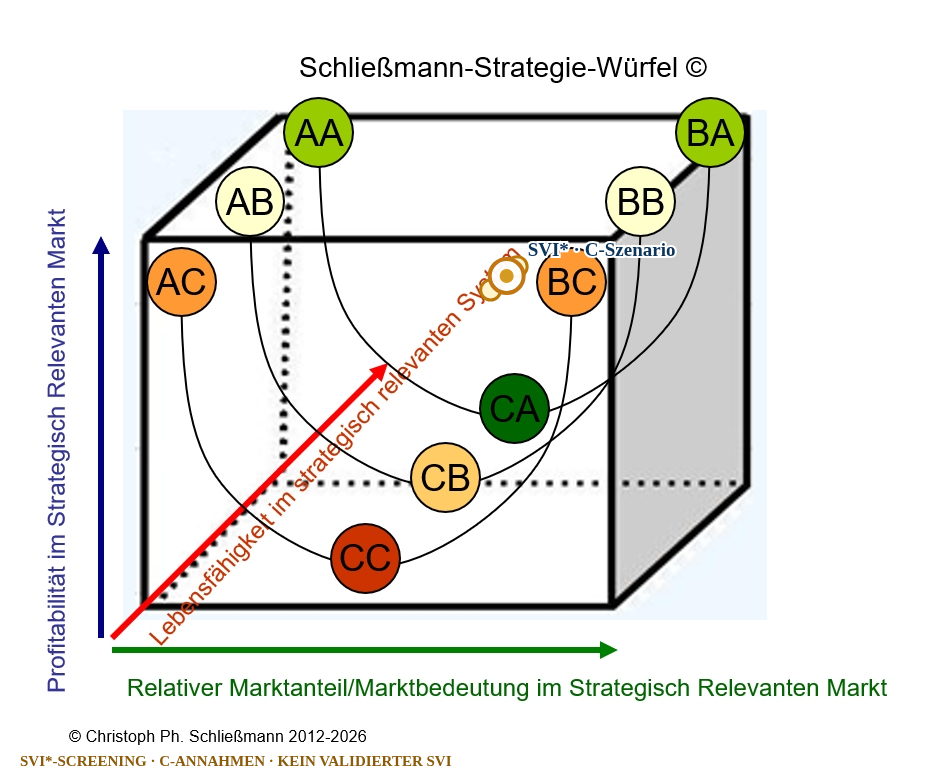
The Schließmann Strategy Cube combines three distinct perspectives:
- Relative Strength in the Strategically Relevant Market,
- Performance in this market and
- Viability within the relevant system.
The cube thus serves as the strategic framework for further analysis.
Relative Strength answers the question of how strongly the company is positioned relative to its actual alternatives and substitutes in the strategically relevant market.
Performance describes the economic quality and sustainability of the current business model.
Viability extends the analysis to the relevant system. It examines whether the company can maintain or reestablish its relevance, value creation, and capacity for action and development, even under changing conditions.
Today's position is summarized in the Current Strategy Cube.
As THE VIABILITY CODE progresses, it explores how this position might change and what position would enable a viable fit in the future.
System DNA and Interdependence
What underpins the business model—and what makes it vulnerable?
Companies consist of interconnected capabilities, resources, people, technologies, processes, customers, partners, capital structures, and external conditions.
Their strategic importance stems largely from their interaction.
THE VIABILITY CODE describes this structure as "system DNA."
It consists of four levels:
's Demand Constants: Stable, fundamental customer needs and long-term value propositions.
's supply-side factors: the company's capabilities, resources, and organizational competencies.
Strategic Chromosomes
: System-Defining Variables and Their Key Interdependencies.
Meta-competencies
: Skills in business model innovation, system adaptation, and complexity management.
Interdependency analysis focuses on the relationships between the relevant variables.
- Which factors are particularly strongly interconnected?
- Where do hubs emerge?
- What interdependencies can trigger chain reactions?
- Which relationships stabilize the system?
- Where is complexity concentrated?
- Which changes in a variable affect numerous other areas of the system?
This results in a systemic view that goes beyond a mere list of strengths, weaknesses, or key metrics.
A highly interconnected factor can be of great significance. At the same time, it can create vulnerability or dependence. Its strategic role emerges only from the specific systemic context.
System before metric
What data is actually relevant to viability?
THE VIABILITY CODE begins with the strategic question and the relevant system.
Only then are the parameters and metrics suitable for diagnosis derived.
Existing key metrics from finance, sales, production, HR, technology, the supply chain, or other business units can serve as important data sources. Their strategic relevance stems from their function within the system under examination.
Therefore, completely different parameters can be decisive for different companies.
One company may need twelve relevant system variables, while another may need forty or seventy.
The number is determined by the system.
Nor are the parameters themselves taken from a standard catalog.
This principle is central to corporate viability:
System before metric.
In this way, the methodology prevents existing controlling structures from automatically defining what should be considered strategically relevant.
Qualitative and Quantitative System Diagnosis
How can interdependencies and complexity be made visible?
System knowledge stems first and foremost from an understanding of the company, its markets, capabilities, relationships, and interdependencies.
Where appropriate data are available, this qualitative assessment can be supplemented with quantitative analysis.
THE VIABILITY CODE therefore combines management expertise, expert assessment, existing company data, and quantitative systems analysis.
Different instruments serve different purposes.
OntoSpace / Ontonix
Quantitative Analysis of Complexity and Interdependence
One tool that can be used in the Schließmann methodology for quantitative systems analysis is OntoSpace from Ontonix.
OntoSpace analyzes multidimensional datasets for systemic relationships, networking patterns, complexity, and structural changes.
This makes it possible to examine questions such as:
- Which variables are particularly closely integrated into the overall system?
- Where are the interdependencies concentrated?
- Which parameters contribute significantly to system complexity?
- Where might hubs emerge?
- How does the system structure change when individual variables change?
- Which system areas are particularly sensitive?
An important principle of analysis is to consider variables within the context of the overall system.
Using so-called "knock-out" analyses, it is possible, for example, to examine how the measured system complexity changes when individual variables are temporarily removed from the model.
This provides insights into parameters that are particularly relevant from a structural perspective.

OntoSpace thus provides a unique mathematical perspective on interdependencies, robustness, and, above all, (critical) complexity.
The results require strategic interpretation.
A parameter that stands out quantitatively is not yet a proven causal driver.
Its significance stems from the business model, system boundaries, strategic issues, and management expertise.
OntoSpace results can therefore be incorporated as quantitative evidence into the subsequent corporate viability assessment.
Schließmann Viability Analytics – SVA
From System Structure to Corporate Viability Assessment
Schließmann Viability Analytics (SVA) was developed to consistently align quantitative analysis with the third axis of the Schließmann Strategy Cube.
The current state of research is SVA v0.11.3 Integrated.
SVA integrates system definition, parameter discovery, business data, interdependencies, complexity, agility, robustness, viability, scenarios, viability trajectories, and the Schließmann Strategy Cube within a common analytical framework.
The same applies here:
System before metric.
First, the strategic question and the system boundaries are defined.
Next, the relevant parameters are identified and operationalized.
Only then are measured values, existing company data, expert knowledge, and additional quantitative analyses taken into account.
As a result, SVA has neither a fixed set of parameters nor a universal KPI catalog.
What does SVA test for?
SVA distinguishes between several levels of analysis, each of which plays a different role in assessing corporate viability.
Structural Coupling
To what extent are the relevant variables of the system interconnected?
The study examines whether individual parameters are largely independent or form part of dense interdependence structures.
Information Overload
Which relationships create additional uncertainty and informational complexity?
SVA also examines nonlinear and informational relationships that would not be adequately reflected by purely linear correlations.
Dynamics
How does the structure of the system change over time?
With suitable time series, it is possible to examine whether relationships between variables stabilize, dissolve, or form anew.
The chronological order of the data must indeed be reliable for this purpose. A random sequence of observations is not interpreted as a system evolution.
Agility
How well can the company identify changes, develop options, learn, and reallocate resources?
Agility is operationalized on a system-by-system basis.
It is not automatically derived from a network structure.
Robustness
What pressures can the system withstand without losing critical functions and strategic substance?
Robustness, too, requires technically sound and documented indicators.
Complexity
What interdependencies, information structures, and dynamic changes must the company address strategically?
SVA does not reduce complexity to a single correlation value.
Structural coupling, informational overload, and dynamic change are examined separately and are only combined to form a more comprehensive diagnosis of complexity once sufficient evidence is available.
Different Data Sets—Same Line of Reasoning
Companies have very different data histories.
SVA takes these differences into account through multiple evidence modes.
Expert Mode
When there is little historical data available, structured expert relationships can serve as the initial system hypothesis.
Transparency is key here: expert opinions remain clearly identifiable as such.
Hybrid Mode
Existing company data and expert knowledge are considered together.
This can also reveal differences between management perceptions and the observed data structure.
Data Mode
Using appropriate time series, interdependencies, information structures, and changes are examined on the basis of the data.
Short-Range Screening
Small and medium-sized enterprises, in particular, often lack long historical time series for all strategically relevant parameters.
SVA v0.11.3 can therefore handle even short data series with care.
Statements are limited to the available evidence.
Missing components remain visibly open or are displayed as a scenario.
SVA is specifically not intended to create a false sense of mathematical precision.
Providing Quantitative Support for Corporate Viability
The conceptual diagnostic heuristic of THE VIABILITY CODE is:
Viability ≈ (Agility × Robustness) / Complexity
The relationship describes a strategic logic of impact.
High agility supports the ability to adapt and reconfigure.
Ruggedness ensures continued functionality and operational capability under stress.
Complexity describes the system requirements that must be processed.
SVA operationalizes this relationship for research and diagnostic purposes.
Agility and robustness are determined using technically documented indicators and calibrations, respectively.
A mere statistical relationship structure should not automatically imply anything about agility or robustness.
Only once the necessary components have been sufficiently identified can an Operational Locksmith Viability Index (SVI) be calculated.
The SVI supports the quantitative assessment of the third dimension of the Schließmann Strategy Cube.
It is currently a research index. A universally applicable standard for corporate viability that has been empirically validated by external sources does not yet exist.
What happens when there is limited data history?
SVA v0.11.3 also includes a viability scenario range.
In this process, preliminary assessments of agility and robustness are linked to various assumed levels of complexity.
The results show how sensitive the viability position could be to various system stresses.
The scenario book is a sensitivity analysis.
It is not a statistical confidence interval, not a measured overall complexity, and not an empirically confirmed actual position.
It is precisely this distinction that is part of the methodological logic of SVA:
Measured evidence, technical calibration, and assumptions must remain distinguishable from one another.
Direct link to the Schließmann Strategy Cube
SVA v0.11.3 integrates quantitative diagnosis directly into the original Schließmann Strategy Cubes.
Relative Strength and Performance are the two market-related dimensions.
Viability forms the Z-axis.
Depending on the available evidence, the Z-dimension can be represented in different ways:
- Functionally documented SVI
as a quantitative viability metric,
scenario band as a preliminary Z-position with visible sensitivity,- manual strategic assumption
as an explicitly identified management assumption, - or an open Z-axis,
, when the available evidence does not support a reliable quantitative conclusion.
This keeps uncertainty visible.
A missing piece of information is not automatically replaced by a number.
What types of analyses does SVA combine?
The current stage of development of SVA combines, among other things:
- Parameter Discovery and System Definition,
- Flexible company data imports,
- Relationships with experts,
- Interdependence matrix,
- interactive system map,
- HUB Diagnostics,
- structural coupling analysis,
- informational relationships,
- quantitative complexity diagnostics,
- Knockout analysis,
- Agility and robustness profiles,
- functional limits,
- Range of Regimes,
- Regime trajectory,
- Viability Trajectory,
- empirical state navigator,
- Schließmann Strategy Cube,
- Scenario and sensitivity analyses,
- Strategy Cockpit,
- Data and Evidence Quality,
- Auditable performance reports.
The application processes various data structures and can be used in both small-to-medium-sized businesses with limited data and organizations with more extensive data environments.
The analysis remains specific to each company.
From Analysis to Management Decisions
Quantitative analysis serves a clear purpose for THE VIABILITY CODE:
It is intended to improve the basis for strategic decision-making.
That is why SVA goes beyond matrices, networks, and mathematical metrics.
The key questions are:
- What is the current strategic situation?
- What variables and relationships shape it?
- Where do vulnerabilities or critical dependencies arise?
- Which changes deserve special attention?
- How is the company's viability changing?
- What strategic implications does this have?
Quantitative analysis provides evidence. Strategic interpretation remains a management task.
OntoSpace and SVA within the Schließmann Methodology
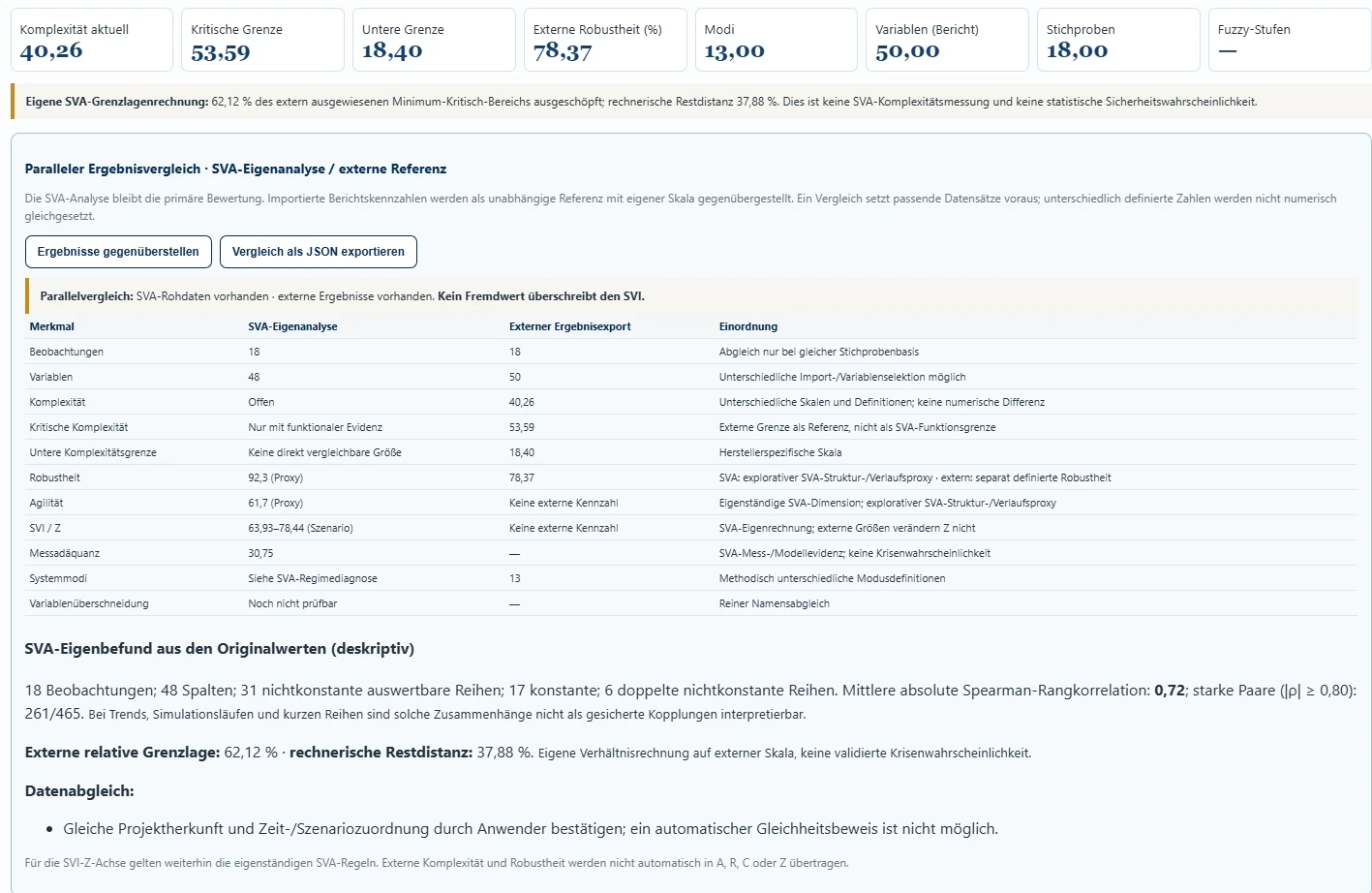
OntoSpace and SVA serve different purposes.
OntoSpace/Ontonix enables an independent mathematical analysis of interdependencies, system structure, and complexity.
Schließmann Viability Analytics integrates quantitative system findings into the broader strategic architecture of Corporate Viability.
To this end, SVA connects:
- relevant system,
- custom parameters,
- Interdependencies,
- Complexity,
- Agility,
- Robustness,
- Viability,
- Scenarios,
- Trajectory
- and its strategic position in the Schließmann Strategy Cube.
Results from OntoSpace can be incorporated into this diagnosis as additional quantitative evidence.
This raises the follow-up question:
What does the observed system structure mean for the company's viability—both today and under changing conditions?
Corporate Viability
How resilient is the current configuration in the face of change?
Corporate viability refers to a company’s ability to maintain or reestablish its relevance, value creation, and capacity for action and development within the relevant system, even under changing conditions.
The heuristic diagnostic logic is as follows:
Viability ≈ (Agility × Robustness) / Complexity
What matters is the relationship within the specific relevant system.
In this context, complexity does not have an exclusively negative connotation.
It can foster diversity, recombination, and innovation.
It becomes strategically critical when the company's ability to perceive, adapt, and absorb is insufficient to effectively manage it.
Corporate viability is therefore always assessed on a system-by-system basis.
Viability Stress Test
What happens when the conditions that led to today's success change?
A strategic position today describes a state of affairs.
It does not yet answer the question of how resilient this state is under changing conditions.
The Viability Stress Test therefore examines strategically relevant changes to the system.
These may include, for example:
- changing customer needs,
- new substitutes,
- technological changes,
- regulatory shifts,
- Failure of critical partners,
- changed financing terms,
- Resource scarcity,
- Changes in supply chains,
- organizational burdens,
- Changes to the business model architecture.
The study examines how this affects capabilities, interdependencies, complexity, and strategic positioning.
This provides a sound basis for determining under what conditions the current fit is adequate and where a refit may be necessary.
Viability Trajectory
Where is the company headed?
Strategic diagnosis is not limited to a snapshot.
The Viability Trajectory describes the evolution of the strategic position over time.
It considers at least three levels:
Level
: Where Do We Stand Today?
Direction
: In which direction are we heading?
Velocity
How fast is our position changing?
Added to this is the change in the context itself.
Customer needs, substitutes, technologies, regulations, or system relationships may shift, while at the same time the company is changing.
This transforms the assessment of the current situation into a dynamic strategic development path.
Business Model Re-Fit
Which new Fit model performs well under changing conditions?
Over the years, companies develop capabilities, processes, technologies, partnerships, and market positions.
This specialization can serve as a key foundation for a competitive advantage in today's market.
If the original customer requirement or the relevant system changes, the existing configuration must be reevaluated.
"Re-Fit" refers to the ability to establish a new, sustainable relationship between
- the customer's original need,
- Strategically Relevant Market,
- The company's capabilities,
- Business model
- and the relevant system
to produce.
In this process, individual measures are evaluated within the context of the overall system.
The question is:
What new configuration can support the next business cycle?
The Future Strategy Cube is derived from the prioritized re-fit options.
Corporate Viability Radar
How can we recognize early on that the strategic situation is changing?
The Viability perspective does not end with the completion of *THE VIABILITY CODE*.
The Corporate Viability Radar translates the relevant insights into an ongoing strategic monitoring framework.
For selected variables and interdependencies, leading indicators, responsibilities, review schedules, and strategic triggers are defined.
This allows company management to monitor,
- whether customers' underlying needs are changing,
- whether new substitutes will emerge,
- whether critical dependencies are growing,
- whether agility or robustness declines,
- whether complexity is increasing,
- whether relationships in the relevant system change
- and whether the strategic position is moving in a critical direction.
Corporate viability thus becomes an integral part of day-to-day business management.
The Methodological Principles of THE VIABILITY CODE
The conceptual framework is based on a few fundamental principles.
- Customer Needs Before Industry Logic
The Strategically Relevant Market is derived from the original customer need and functional substitutes. - System vs. Key Performance Indicator (
): Parameters and metrics are developed based on strategic questions and the relevant system. - Relationships Over Isolated Factors
The strategic significance of individual variables stems largely from their interdependencies. - Evidence Over Apparent Accuracy
Qualitative assessments, quantitative measurements, and assumptions are clearly distinguished from one another. - Movement Before the Snapshot
Position, direction of development, speed, and changes in the strategic context are considered together. - Diagnosis Leads to a Re-Fit
Strategic analysis derives its value from the ability to develop a new, viable configuration based on it. - Monitoring will continue following the development at
. Viability will continue to be monitored after the analysis is complete, based on relevant early indicators and system changes.
An architecture—a company-specific application
THE VIABILITY CODE features a clear framework for thinking and diagnosis.
Its specific application depends on the business model, strategic issues, relevant system, and available evidence.
System boundaries, parameters, data sets, operationalization, stress scenarios, and re-fit options are developed individually for each company.
In this way, a consistent methodology gives rise to a company-specific corporate viability framework for strategic decisions.
THE VIABILITY CODE – The Program
Executive Viability Briefing
A personal and confidential consultation with Prof. Dr. Christoph Ph. Schließmann regarding your company’s strategic position and viability.