Publications · Working Papers · Research Development
Research
The Scientific Development Behind THE VIABILITY CODE
THE VIABILITY CODE is the culmination of a strategic and systemic line of research developed over many years by Prof. Dr. Christoph Ph. Schließmann.
The focus is on these fundamental questions:
- How can a company's actual strategic playing field be determined?
- How do interdependencies and complexity affect his ability to act?
- How can strategic positioning be expanded to include the dimension of viability?
- How does this position change over time?
- And how can a company establish a new, sustainable fit under changing conditions?
This development spans from interdependence and systemic complexity, through the Schließmann Strategy Cube—first published in 2012—to current research on corporate viability, viability trajectory, Re-Fit, and quantitative viability diagnostics.
The Line of Development
2010 · Interdependence
*Interdependency: Understanding Systems, Avoiding Domino Effects*, published by Bank-Verlag, was the first comprehensive presentation of my systemic perspective on interdependence.
The focus was on the relationships between system variables, their mutual reinforcement, potential domino effects, and the question of how organizations can remain capable of acting within complex systems.
In this context, the analysis of individual factors takes a back seat to the question of how these factors are interconnected and what systemic effects arise from their relationships.
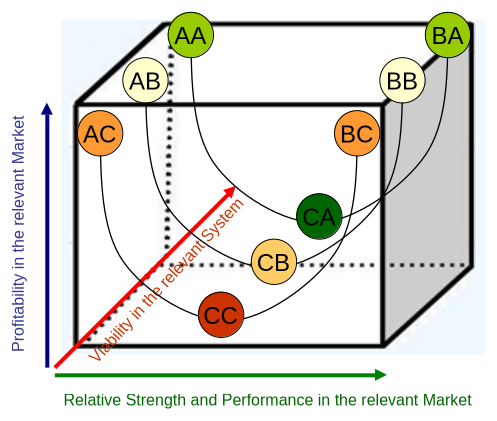
2012 · The Schließmann Strategy Cube
With this post
The New Dimension of Strategic Thinking
The Schließmann Strategy Cube was published for the first time.
The model adds a third dimension to strategic positioning:
Viability—the company's ability to survive within the relevant system.
Relative Strength describes strength in the strategically relevant market.
Performance describes the economic quality and sustainability of the business model.
Viability examines whether the company remains capable of acting, adapting, and developing under changing system conditions, or whether it can reestablish this capability.
This expanded the traditional view of market position and economic performance to include the systemic sustainability of the strategic configuration.
About the Schließmann Strategy Cube
2014 · The Concept of Interdependence
In 2014, Springer Gabler published the second edition, which had been substantially revised:
The Concept of Interdependence. Recognizing and managing the opportunities and risks of systemic complexity.
This work delves deeper into the study of interconnectedness, complexity, feedback loops, risks, and viability in business systems.
These works provide an essential methodological foundation for today's system DNA and interdependency analysis, as well as for the further development of corporate viability.
2026 · Corporate Viability
The working papers published in 2026 build on this development to form a more comprehensive theory of strategic viability.
The focus is particularly on:
- Corporate Viability as the Third Dimension of Strategic Management,
- the dynamic evolution of the Schließmann Strategy Cube,
- Viability Trajectory,
- Viability Leadership,
- Re-fit capability,
- System migration,
- Original Customer Need and Strategically Relevant Market,
- The Limits of Bottleneck-Oriented Strategies
- as well as the quantitative operationalization of corporate viability.
Fundamental Works by Christoph Ph. Schließmann
The Concept of Interdependence
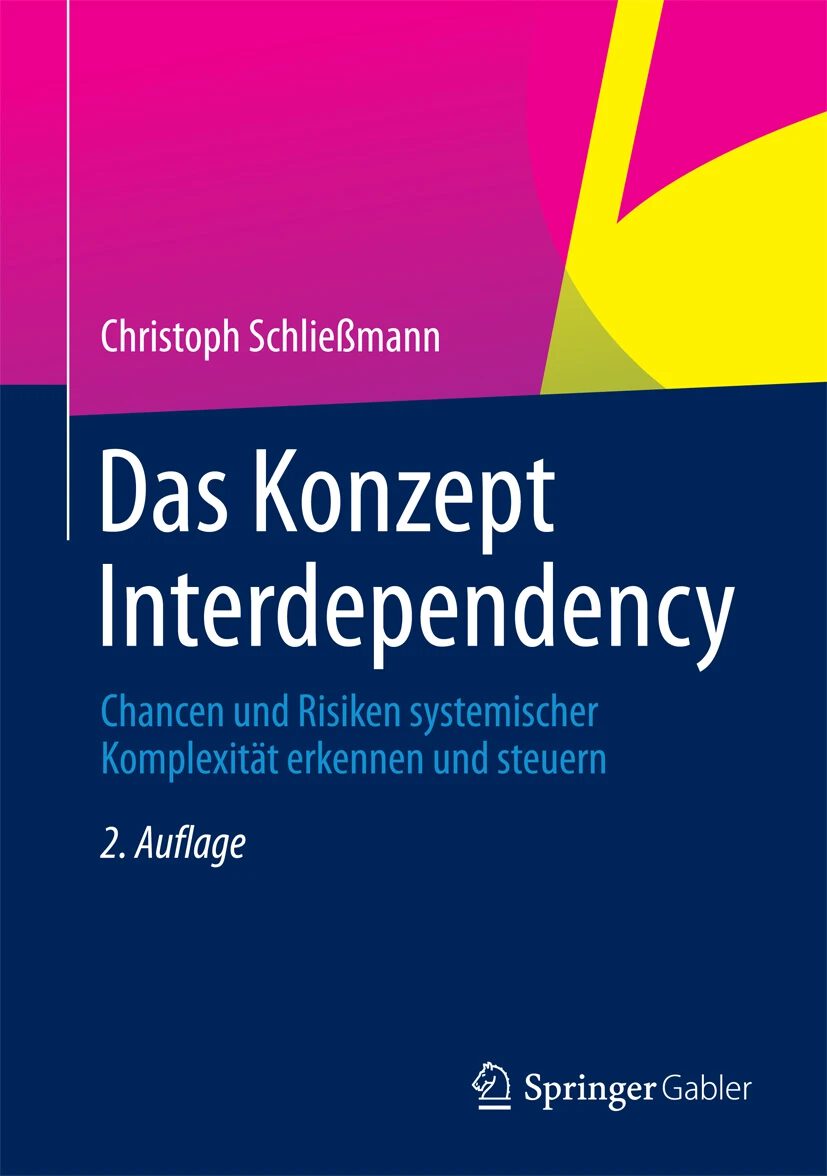
Christoph Ph. Schließmann
The Concept of Interdependence: Identifying and Managing the Opportunities and Risks of Systemic Complexity.
2nd edition, Springer Gabler, Berlin/Heidelberg 2014.
First edition: *
* *Interdependency: Understanding Systems, Avoiding Domino Effects*. *
* Bank-Verlag, Cologne 2010.
The book develops a systemic perspective on organizations, networking, complexity, and viability. It serves as a key starting point for today's interdependency and System DNA analysis.
The New Dimension of Strategic Thinking
Christoph Ph. Schließmann
"A New Dimension in Strategic Thinking."
In: Kaltenbrunner, K. A.; Urnik, S. (eds.): *
: Corporate Management—State of the Art and Development Perspectives*. *
* Oldenbourg, Munich 2012, pp. 159–173.
This article presents the first publication of the Schließmann Strategy Cube, which incorporates viability as a distinct third dimension of strategic corporate management.
The Systemic Perspective
Christoph Ph. Schließmann
“The Systemic Perspective: Systemic Viability as a Key Success Factor.”
In: Business + Innovation, Issue 4/2012, Springer Gabler, pp. 40–52.
This article explores in depth how systemic relationships and sustainability can be integrated into strategic corporate management.
Working Papers on Corporate Viability
Since June 2026, Prof. Dr. Christoph Ph. Schließmann has been publishing his latest research as working papers on SSRN, listing his affiliation as Paris Lodron University of Salzburg.
Working papers document ongoing research. They facilitate scholarly discussion and further development prior to a possible future publication in final form.
All working papers on the SSRN author page
July 14, 2026
Beyond Market Positioning
Systemic Viability as a Third Dimension of Strategic Management
SSRN 7019638
The paper develops "viability" as a distinct third dimension of strategic management and brings together market position, economic performance, and systemic viability within a shared strategic framework.
September 24, 2026
The Moving Strategic Coordinate System
A Dynamic Formalization of the Schließmann Strategy Cube
SSRN 7506380
The paper formalizes the Schließmann strategy cube as a dynamic strategic coordinate system.
It distinguishes between strategic position, change, the dynamics of change, and contextual migration.
This takes into account the fact that it is not only the company that changes, but the strategic context itself can also change.
November 10, 2026
From Customer Needs to Strategically Relevant Markets
Integrating Kano Analysis and Customer Value Propositions into a Traceable Strategy Intelligence Architecture
SSRN 7681560
This paper develops a clear framework that spans from the customer's original needs through Kano analysis and the customer value proposition to the definition of strategically relevant markets.
The focus is on the question of how original customer needs, perception of product features, comparisons of benefits, and the substitution space can be linked without limiting the market definition to existing products or industries.
November 9, 2026
Beyond the Bottleneck
Original Customer Needs, Strategic Archetypes, and the Lifecycle Limits of the Mewes/EKS Strategy
English: Beyond the Bottleneck
SSRN 7681562
This study examines bottleneck strategies as a specific strategic archetype.
It distinguishes between the life cycle of a bottleneck solution, the life cycle of the bottleneck itself, and the life cycle of the system architecture that causes the bottleneck.
The key question regarding corporate viability is:
What remains of a strategy if the bottleneck on which its current success is based no longer needs to exist?
August 19, 2026
From Bottleneck Fit to Corporate Viability
The Mewes/EKS Strategy in the Dynamic Architecture of the Schließmann Strategy Cube
SSRN 7298058
This study examines the difference between a successful current fit and the ability to establish a new fit when system conditions change.
This makes "Re-Fit Capability" an essential meta-competency for long-term corporate viability.
August 5, 2026
Viability Leadership in Complex Systems
SSRN 7172458
The paper conceptualizes leadership as a dynamic meta-competency in complex systems.
The focus is on agility, resilience, responsiveness, governance, and the ability to sustain learning and regeneration amid increasing complexity.
July 14, 2026
From Excellence to Viability
Why Lasting Corporate Success Depends on Systemic Capabilities, Not on Time Horizons
SSRN 7061718
The paper distinguishes between excellence, longevity, and viability.
Long-term success stems from the ability to repeatedly create a new, sustainable state in response to changing circumstances.
June 29, 2026
From Tin Man to Octopus in the Schließmann Strategy Cube
Viability as the Third Dimension of Strategic Management
SSRN 6965701
This work supplements the viability assessment by adding an organizational perspective.
The octopus metaphor represents decentralized perception, local agency, learning, and adaptation while maintaining systemic coherence.
Life-Changing Encounters
In addition to academic literature and my own research, three encounters have had a significant influence on my strategic work.
Robert A. Burgelman, Jerry I. Porras, and Clayton M. Christensen.
Her work addresses a variety of issues: strategic path dependence and corporate development, the long-term sustainability of organizations, disruptive changes, and the perspective on the actual customer problem.
These ideas have been incorporated into my own strategic work, without compromising the independence of the Schließmann architecture that was later developed from them.
Robert A. Burgelman
Strategy Is Destiny
One particularly formative personal encounter was with Robert A. Burgelman of the Stanford Graduate School of Business in 2005.
His understanding of strategy as an ongoing process of corporate development and his book *Strategy Is Destiny* have had a lasting influence on my view of strategic change.
Burgelman examines how companies create development paths through their own strategic processes and how successful strategic configurations can both enable and limit a company's future development.
This is particularly relevant to my future work on corporate viability:
A strategy that is successful today does more than just shape market position and performance. It shapes capabilities, resources, decision-making logic, and organizational routines—and, in doing so, also determines how easy or difficult a future strategic overhaul will be.
In this way, current success can itself become part of future strategic commitment.
Robert A. Burgelman
, *Strategy Is Destiny: How Strategy-Making Shapes a Company’s Future*.
Free Press, New York 2002.
Jerry I. Porras
Built to Last
Another encounter that was particularly important to me personally was the one with Jerry I. Porras of Stanford University.
I met him in person in 2005 and worked with him. In 2007, I invited him to the University of Salzburg for a symposium lasting several days.
His book *Built to Last*, co-authored with Jim Collins, has had a lasting impact on my exploration of companies' long-term sustainability.
The central question remains relevant to my own research to this day:
What distinguishes companies that are able to remain successful over long periods of time from those whose success is tied to a specific configuration or phase?
Porras draws attention to the underlying structures, values, and organizational prerequisites of companies that achieve lasting success.
This perspective provided important inspiration for my later work on corporate viability. At the same time, viability research takes the line of inquiry in a different direction.
Longevity alone is not sufficient proof of viability.
The key factor is whether a company is able to reestablish its relevance and capacity to act in the face of changing market and systemic conditions.
This shifts the question from
"What makes companies successful in the long run?"
to
"What capabilities enable a company to consistently develop a new, viable fit in the face of changing conditions?"
It is precisely at this point that the insight from *Built to Last* connects with my later distinction between excellence, longevity, and corporate viability.
James C. Collins / Jerry I. Porras, *
* *Built to Last: Successful Habits of Visionary Companies*.
HarperBusiness, 1994.
Clayton M. Christensen
Disruptive Innovation and Jobs to Be Done
Equally influential for me was my exploration of the insights of Clayton M. Christensen of Harvard Business School.
Two ideas from his work are particularly significant from my strategic perspective.
Disruptive Innovation
Christensen's work on disruptive innovation shows that successful companies can overlook or misjudge developments, even though they professionally serve their existing customers, markets, and business models.
Success within an existing market and business model framework, in particular, can make it difficult to see new solution architectures.
This perspective directly addresses the question of strategic viability:
How sustainable is today's success if customer needs, technology, or system architecture change?
Jobs to Be Done
The second key concept is "Jobs to Be Done."
The key focus is on what task or problem a customer actually wants to solve.
This idea is closely linked to my work on core customer needs and the strategically relevant market.
The solution architectures that are strategically relevant are those that can achieve the same desired state as the customer—regardless of whether they originate from the same traditional industry.
"Jobs to Be Done" and the original customer need are not identical concepts.
For my own work, however, the consistent shift in perspective—from the existing product to the customer's actual problem—proved to be a major source of inspiration.
Clayton M. Christensen
, *The Innovator’s Dilemma*.
Harvard Business School Press, 1997.
Clayton M. Christensen, Taddy Hall, Karen Dillon, David S. Duncan, *
* *Competing Against Luck: The Story of Innovation and Customer Choice*. *
* HarperBusiness, 2016.
Three Ideas—An Original Development
These influences can be seen in various forms in my later work:
- in the customer's original need and the strategically relevant market,
- in the Schließmann Strategy Cube,
- in distinguishing between performance and viability,
- in Viability Trajectory and Context Migration
- as well as in the ability to carry out strategic refits.
THE VIABILITY CODE integrates these questions today within a self-contained Schließmann architecture.
Current Areas of Research
Current research focuses on several interrelated questions.
Corporate Viability
How can viability, as a distinct strategic category, be precisely distinguished from performance, resilience, robustness, agility, and longevity?
Viability Trajectory
How can we track the level, direction, and velocity of strategic viability over time?
Context Migration
How does strategic diagnosis change when not only the company but also its relevant context changes at the same time?
Re-Fit Capability
What capabilities enable a company to develop a new, viable configuration when system conditions change?
Strategically Relevant Market
How can a customer’s original need, substitutes, and alternative solution architectures be combined into a coherent strategic market model?
Schließmann Viability Analytics
How can interdependence, complexity, agility, robustness, and viability be quantitatively analyzed without creating false precision?
The current state of research is SVA v0.11.3 Integrated.
A key focus of the next phase of research will be on empirical validation using historical corporate trajectories.
Scientific Points of Reference
Further Reading
Schließmann's research is situated within a broader scientific context encompassing strategy, cybernetics, systems theory, complexity research, innovation, and customer orientation.
These works serve as scholarly points of reference and sources of intellectual inspiration.
THE VIABILITY CODE is not derived genealogically from these concepts. It combines these perspectives into a unique framework consisting of original customer needs, strategically relevant markets, the Schließmann Strategy Cube, interdependency, corporate viability, viability trajectory, and Re-Fit.
W. Ross Ashby
An Introduction to Cybernetics
Ashby's work is among the foundations of cybernetics.
From the perspective of viability, the question of what degree of variability a system of control and action requires in order to cope with the variability of its environment is particularly relevant.
This logic serves as an important scientific reference point for addressing the question of how organizations can manage complexity.
Stafford Beer
Viable System Model
With the Viable System Model, Stafford Beer developed one of the key cybernetic frameworks for organizational viability.
His work focuses on controllability, autonomy, recursion, variety, and the question of what structures organizations need to remain viable under complex conditions.
His major works include:
Brain of the Firm.
The Heart of Enterprise.
Fredmund Malik
Management of Complex Systems
Fredmund Malik's systemic-evolutionary management theory combines systems science, cybernetics, and the management of complex organizations.
The question of how leadership can remain effective in the face of complexity is one of the key focal points of my own exploration of systemic business management.
One of his major works is:
Strategy for Managing Complex Systems.
Frederic Vester
Networked Thinking and the Sensitivity Model
With his sensitivity model, Frederic Vester developed an important approach to analyzing complex systems and reciprocal interactions.
Distinguishing between variables with different levels of influence and examining feedback loops and interconnections provide an important scientific framework for systemic interdependency analysis.
Major Work:
The Art of Thinking in Networks.
Michael E. Porter
Competitive Strategy
Porter's work serves as a key reference point in classical strategic market and competitive analysis.
His perspective on competitive position and industry structure forms part of the historical foundation of strategic positioning models.
Schließmann Architecture broadens this perspective, in particular, through:
- the functional definition of strategically relevant markets,
- Viewing substitutes from the perspective of the customer's original need
- and viability as the third strategic dimension.
Major Work:
Competitive Strategy.
Noriaki Kano
Customer Requirements and the Impact of Characteristics
The Kano model distinguishes between the different effects that performance characteristics have on customer satisfaction.
In current Schließmann research, Kano is applied within a broader framework that links the original customer need, the customer value proposition, and the strategically relevant market.
The purpose here is not to derive the SRM solely from customer surveys. Kano constitutes a layer of evidence within a broader strategy intelligence architecture.
Mewes/EKS as a Strategic Reference Point and Subject of Research
The work of Wolfgang Mewes and the Bottleneck-Focused Strategy are characterized by a consistent focus on customer value, minimum factors, and bottlenecks.
My works from 2026 also examine this strategy in terms of its systemic limitations.
A bottleneck can be caused by the existing system architecture itself.
If this architecture changes, the bottleneck may also change or disappear.
The analysis therefore distinguishes between:
- the life cycle of the bottleneck solution,
- the life cycle of the bottleneck
- and the life cycle of the system architecture that causes the bottleneck.
Corporate viability becomes particularly relevant at the third level.
Mewes/EKS is thus examined as a specific strategic archetype—not as the origin of THE VIABILITY CODE.
Other Publications by Christoph Ph. Schließmann
The complete publication history dates back to the early 1980s and includes books, scholarly articles, and other publications on topics such as:
- Corporate Strategy,
- systemic corporate management,
- Interdependence and complexity,
- Guided tour,
- Business Succession,
- international business law,
- Contract Drafting
- and other business-related issues.
Essay 2026
Strategy in the Age of Artificial Intelligence
On Leadership, Understanding Systems, and the Viability of Companies
This essay examines strategic leadership in the context of artificial intelligence and increasing system complexity.
The focus is on the question of what role leadership, judgment, understanding of systems, and human responsibility play as analysis and decision-making processes are increasingly supported by artificial intelligence.
Strategy, Leadership, and Governance in the Age of Artificial Intelligence
These two executive publications explore the impact of artificial intelligence on business models, strategic management, judgment, and decision-making responsibility. They extend the systemic perspective of my work on interdependence into the context of increasingly interconnected human-AI systems.
AI Leadership Transition
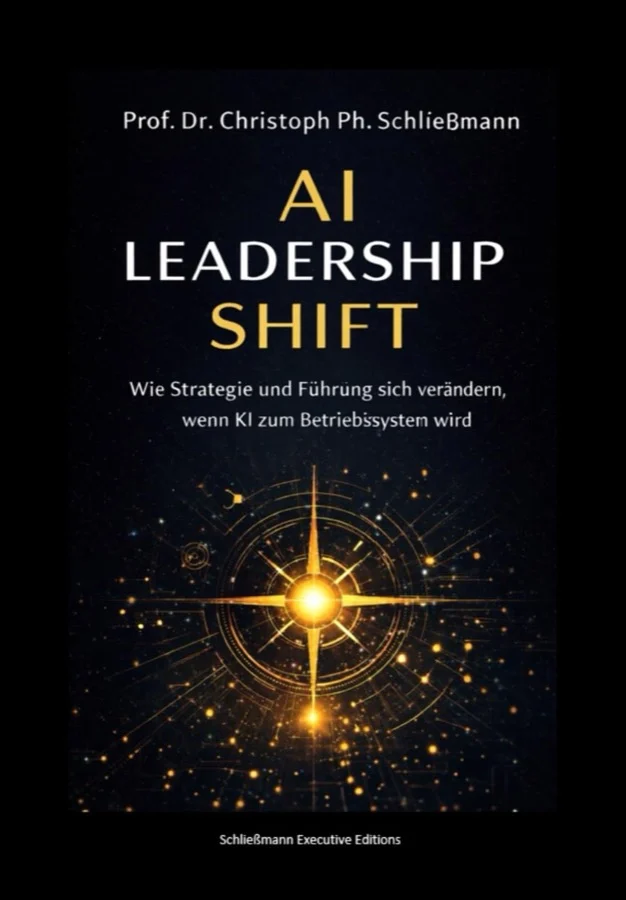
How Strategy and Leadership Change When AI Becomes the Operating System.
Schließmann Executive Editions, December 2025.
This publication examines how artificial intelligence is changing the conditions for competition, value creation, and leadership, and what strategic implications this has for corporate management.
Governance and Leadership
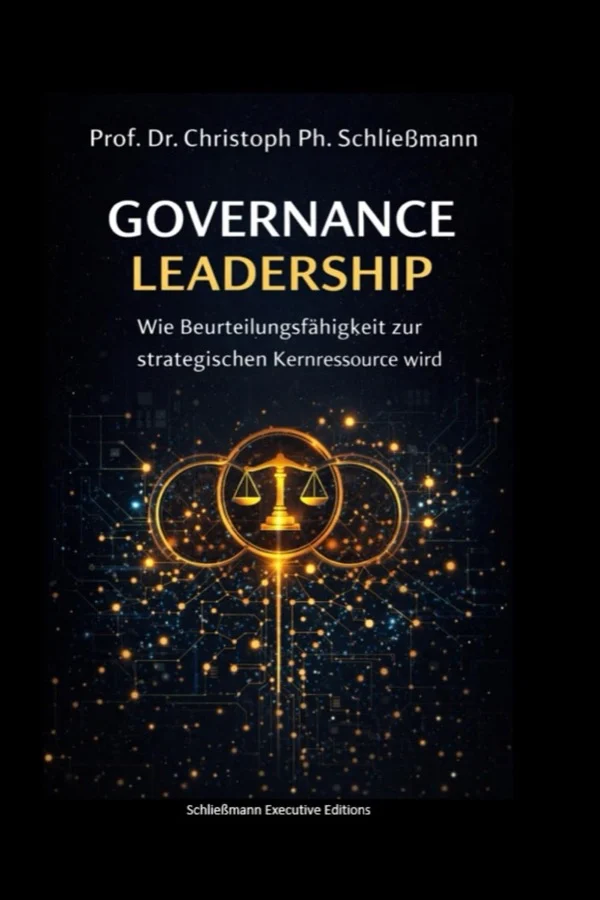
How Judgment Becomes a Core Strategic Resource.
Schließmann Executive Editions, January 2026.
The publication, which builds on this, explores in greater depth how companies can institutionally embed judgment, decision-making responsibility, and governance within the context of AI-supported processes.
Research and Application
THE VIABILITY CODE translates this research into a structured strategic diagnostic and development process for real-world companies.
The scientific studies provide the theoretical framework.
Interdependency, the Schließmann Strategy Cube, Corporate Viability, Viability Trajectory, Re-Fit, and Schließmann Viability Analytics combine these developments into a unified methodological framework.
The research remains open to further development and empirical testing. Its application translates this into strategic decision-making capabilities.