
For entrepreneurs, executives, and advisory board members who are responsible for ensuring the long-term viability of their companies.
Strong.
Profitable.
Viable?
THE VIABILITY CODE
: The Schließmann Program for Strategic Viability.
Companies can be strong in the market and economically successful while simultaneously losing strategic viability. Others are already facing pressure related to earnings, liquidity, or change and must develop a new, sustainable model. THE VIABILITY CODE shows how resilient today’s business model is within the relevant system and what strategic developments will ensure or restore its viability.

Initial Situation 1
We are successful. Will we remain viable?
Market position and financial figures are compelling. At the same time, customer needs, substitutes, technologies, regulations, resources, and dependencies are changing. The key question is whether today’s strategic fit will remain viable under changing conditions.
Initial Situation 2
We're under pressure. How can we become viable again?
Earnings, liquidity, market position, and business models are already under pressure. Even in a crisis, operational stabilization alone is not enough. It is crucial to understand the strategic root causes within the relevant system and to use that understanding to develop a new, sustainable alignment between the market, capabilities, and business model.
The Key Strategic Question
Success and crisis both raise the same question about the future.
How viable is your company within the relevant system—and which next step will prove most effective?
Relative Strength
How strong are we in our actual strategic market?
The assessment focuses on relative strength compared to the relevant alternatives and substitutes in the Strategically Relevant Market (SRM).
Performance
How economically viable is our current business model?
The focus is on the economic quality and sustainability of the current position in the relevant market.
Viability
How viable are we within the relevant system?
The study examines whether the company remains capable of acting, adapting, and developing under changed conditions, or whether it can restore this capability.
A company can be strong and profitable yet still lose its viability. A company under pressure can regain its viability if it develops a new, sustainable strategic fit.
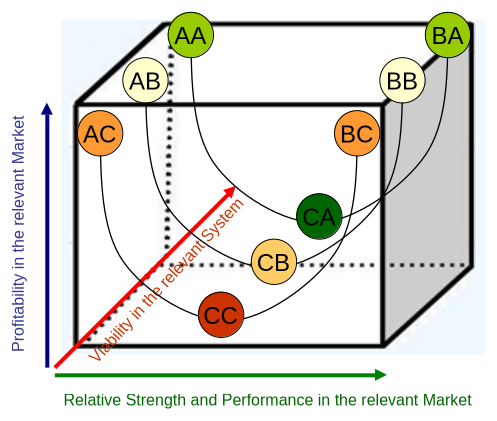
The Core Model
The Schließmann strategy cube
Three Dimensions of Strategic Reality.
Three Dimensions of Strategic Reality.
The Schließmann Strategy Cube combines three distinct perspectives: relative strength in the strategically relevant market, performance in that market, and viability within the relevant system. Together, they describe a company’s strategic position and its sustainability under changing conditions.
The third dimension, corporate viability, is system-specific. The factors that determine a company’s viability depend on its business model, the relevant system, and the actual interdependencies. For this reason, there is no general, standard checklist.
The dynamic formalization published in 2026 expands the cube to include the dimensions of time and context: Companies change their position, while at the same time the strategically relevant context may shift. This gives rise to the perspective of the viability trajectory.
Corporate Viability
Viability is a strategic performance metric.
Corporate viability describes a company’s ability to maintain or reestablish its relevance, value creation, and capacity for action and development within the relevant system, even under changing conditions. In *THE VIABILITY CODE*, it is assessed based on the specific structure of the relevant system.
Heuristic Diagnostic Logic
Viability ≈ (Agility × Robustness) / Complexity
The relation is a strategic diagnostic heuristic. It is not a universal mathematical law.
Agility
How early does the company recognize changes, how quickly does it develop courses of action, learn, and reallocate resources?
Robustness
What pressures can the system withstand without losing its critical functions and strategic substance?
Complexity
What interdependencies, feedback loops, diversity of information, and nonlinear relationships must the company navigate?
The key factor is the relationship: complexity becomes a critical issue when agility and robustness are insufficient to manage it strategically.
THE VIABILITY CODE
About twelve weeks. Seven Gates. Your company.
The leadership team is working on the company's actual strategic situation. The seven gates lead from the actual strategic playing field, through systemic diagnosis, to the next viable re-fit and its ongoing monitoring.
Phase I · Gate 1–2
: Strategic Clarity
Phase II · Gate 3–4
Systemic Diagnosis
Phase III · Gate 5–7
Stress · Re-Fit · Radar
1
DEFINE THE REAL GAME
Are we playing on the right strategic field?
Results SRM Map
Clear Strategic Reference Area
2
FIND THE BUSINESS
Where do we really stand today?
Results:
Current Strategy Cube:
Joint Assessment
3
DECODE THE SYSTEM'S DNA
What underpins our business model—and what does it depend on?
Results: System DNA Map
Critical Interdependencies
4
MEASURE VIABILITY
How viable is today's strategic configuration?
Results
Corporate Viability Profile
Drivers, Risks, Evidence
5
PUT THE SYSTEM UNDER STRESS
What changes when the foundations of our success come under pressure?
Results
's Viability Stress Tests
Viability Trajectory
6
DESIGN THE RE-FIT
What strategic fit will drive the next business cycle?
Results
, Business Model Re-Fit
, Future Strategy Cube
7
INSTALL THE VIABILITY RADAR
How can we recognize early on that our strategic situation is changing again?
Results Corporate Viability Radar
90/180/365-Day Roadmap
The gates are visible. The diagnosis remains specific to each company.
THE VIABILITY CODE does not rely on a universal, standard strategy. System boundaries, parameters, data, operationalization, and interpretation are developed based on the specific strategic question and the company’s relevant system. This results in a unique corporate viability framework to guide management decisions.
How It Works
In a real-world company. With a leadership team, system knowledge, and data.
The process combines strategic analysis, collaborative work by the leadership team, and—where it provides reliable insights—quantitative evidence.
- Executive Interviews
: Strategic issues, system boundaries, and different leadership perspectives come into focus. - Leadership
The executive team and selected managers develop a shared strategic assessment of the situation.
System Diagnosis: Variables, interdependencies, hubs, and critical dependencies are examined in a structured manner.- Data & Scenarios
Existing data and plausible future scenarios enhance the diagnosis when they provide additional reliable evidence.
The result
What is available after the program
A shared strategic overview and a solid foundation for future decisions.
- SRM Map
: Original Customer Need, Substitutes, and the Actual Strategically Relevant Market. - Current Strategy Cube
Today's position in terms of Relative Strength, Performance, and Viability. - System DNA Map
Core capabilities, system variables, hubs, and critical dependencies. - Corporate Viability Profile
: Agility, robustness, relevant complexity, and key viability drivers. - Viability Stress Tests & Viability Trajectory
Tested system states and the evolution of the strategic position. - Business Model Re-Fit
: Prioritized options for a new, sustainable fit. - Future Strategy Cube
The strategic vision for the next business cycle. - Corporate Viability Radar
Leading indicators, triggers, and a 90/180/365-day roadmap.
When the program becomes particularly relevant
Ensure viability. Or restore it.
A Strong Starting Point
Today's "Fit" is still going strong—but conditions are changing.
Strong growth, new substitutes, technological change, internationalization, M&A, or succession can alter the conditions that have driven past success. THE VIABILITY CODE examines how these changes affect a company’s viability before they are fully reflected in its earnings and market position.
Under Pressure
Today's size is already too small.
When earnings, liquidity, market position, or the business model come under pressure, THE VIABILITY CODE focuses on the strategic question of future viability: What are the underlying causes within the relevant system—and what is the next viable path forward?
THE VIABILITY CODE is a strategic analysis and development program. In acute crises, an assessment under insolvency law, restructuring law, or financial law may be necessary at the same time.

Family-owned and operated
Prof. Dr. Christoph Ph. Schließmann
Business attorney, adjunct professor of business and law, author and creator of the Schließmann Strategy Cube, and developer of THE VIABILITY CODE.
For more than three decades, Christoph Ph. Schließmann has been working at the intersection of corporate strategy, systemic thinking, business model development, and business law. His work combines academic research with business practice and strategic decision-making.
- 2009–2014
: Interdependency—Research on Viable Systems - 2012
Schließmann Strategy Cube - 2026
Corporate Viability Research & Development
Research
Developed through research and practical experience.
THE VIABILITY CODE brings together a long-standing line of development: systemic interdependency and complexity analysis, the third dimension of the Schließmann Strategy Cube published in 2012, and current research on corporate viability, dynamic strategic coordinate systems, viability trajectories, and Re-Fit.
- 2010 / 2014· Interdependence
- 2012· Schließmann Strategy Cube
- 2026· Corporate Viability Research
Executive Viability Briefing
How viable is your business—and what’s the next step that will keep it afloat?
A 30-minute one-on-one discussion about your company’s strategic starting point. The focus will be on whether THE VIABILITY CODE provides a suitable framework for analysis and development in this context.